Phishing remains one of the most successful attack methods in modern cybersecurity.
Despite advances in security technologies, cybercriminals continue to gain access to corporate email accounts, cloud services, VPNs, development platforms, and business applications by exploiting a simple reality: people can be deceived.
Most phishing attacks do not target servers, firewalls, or encryption algorithms. They target employees.
An email appears legitimate. A login page looks authentic. A request seems urgent. A user enters credentials, approves a login request, or types a one-time code.
Within seconds, an attacker may gain access.
At Smart Lab, we help organizations move beyond reactive defenses and implement phishing-resistant authentication based on FIDO2 and CybKey security authenticators.
The goal is simple: eliminate the ability to steal credentials in the first place.
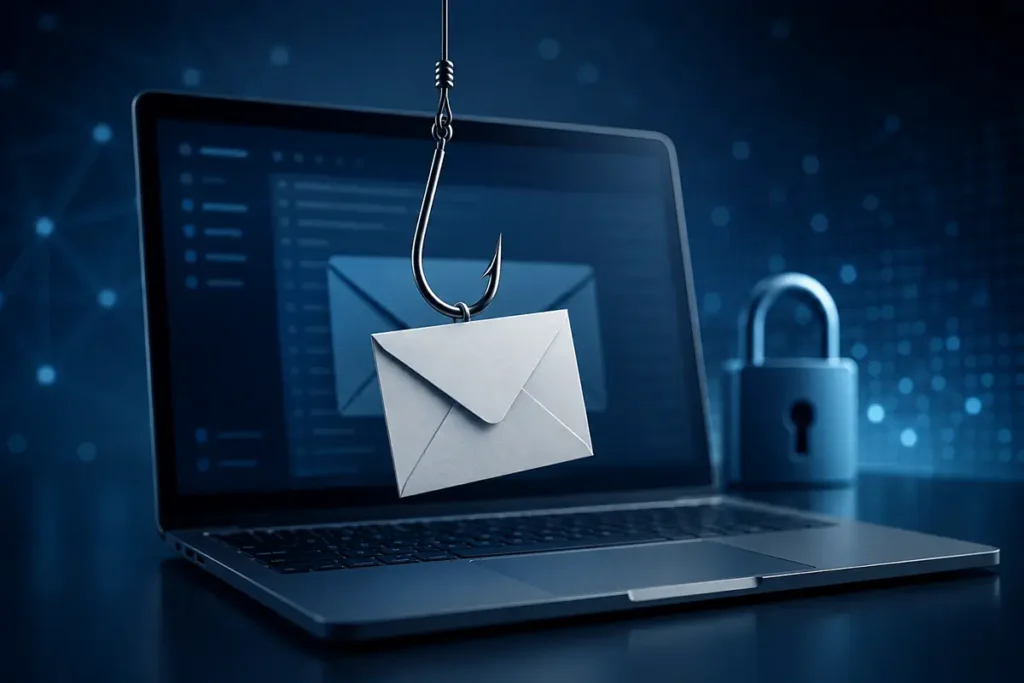
Why Phishing Continues to Succeed
For many years, organizations have relied on usernames, passwords, and one-time verification codes to secure access to business systems.
While these methods improve security compared to passwords alone, they still share the same fundamental weakness.
The user is responsible for recognizing whether a website, email, or login request is legitimate.
Modern phishing campaigns can be remarkably convincing. Attackers replicate corporate branding, imitate trusted services such as Microsoft 365 or Google Workspace, and create login pages that are nearly indistinguishable from the originals.
Even experienced users can make mistakes.
This is not necessarily a training problem. It is often an architectural problem.
If a system allows credentials to be entered into a fraudulent website, sooner or later someone will do exactly that.
Passwords Are a Form of Security Debt
Passwords are easy to deploy. They are inexpensive, universally supported, and familiar to users.
However, they create hidden long-term costs.
A password must be created, remembered, stored securely, changed when compromised, and never reused across services. Organizations invest time and resources into password policies, password managers, reset procedures, and user awareness training.
Yet the underlying risk remains.
The business is still placing critical responsibility on individual users.
As organizations grow, this model becomes increasingly difficult to manage. Remote employees, cloud services, administrative accounts, contractors, and third-party integrations all increase the attack surface.
What initially appeared to be a simple authentication mechanism gradually becomes a management liability.
Passwords may seem inexpensive today. The real cost often appears later.
Security Should Not Depend on Perfect Human Behavior
Many companies respond to phishing threats by increasing employee awareness programs.
Training is important. Employees should understand how phishing attacks work and how to recognize suspicious activity.
However, training alone cannot eliminate risk.
People get distracted. They work under pressure. They travel. They check email from mobile devices. They make mistakes.
A security strategy based entirely on perfect human behavior is ultimately fragile.
Modern cybersecurity increasingly focuses on a different principle:
Design systems that prevent critical mistakes from becoming critical incidents.
This is exactly what phishing-resistant authentication aims to achieve.
What Is Phishing-Resistant Authentication?
Phishing-resistant authentication is designed to ensure that credentials cannot be stolen and reused by attackers.
The most widely adopted approach today is based on the FIDO2 and WebAuthn standards.
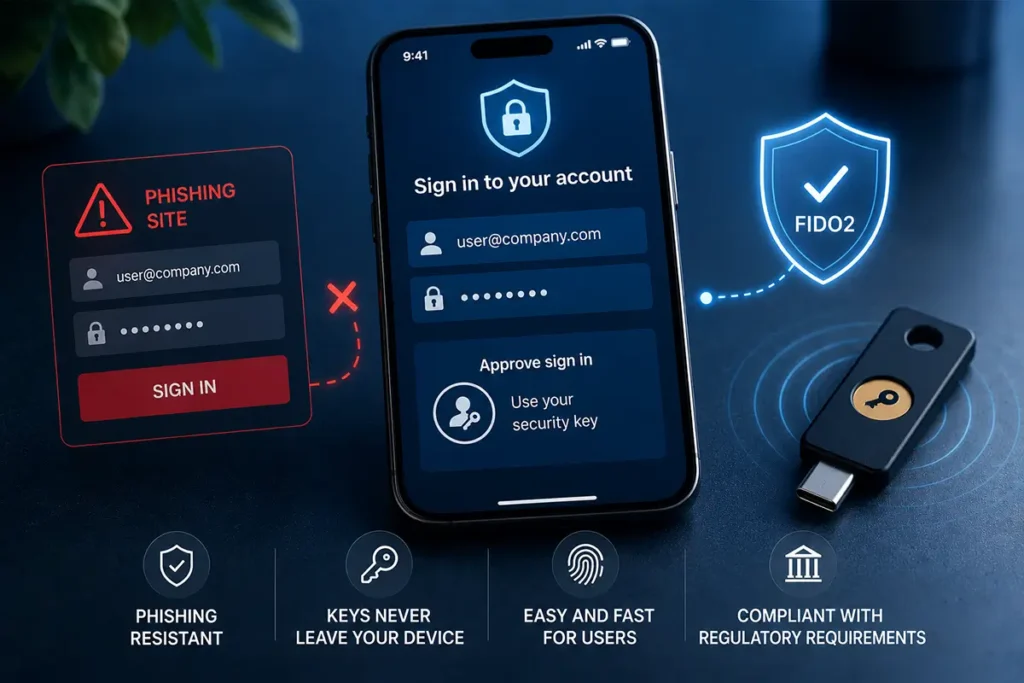
Instead of transmitting passwords or shared secrets to a website, the user authenticates using cryptographic keys.
During registration, a unique key pair is created for a specific service. The public key is stored by the service. The private key remains securely protected inside the authenticator and never leaves the device.
When a login request occurs, the authenticator verifies that the request originates from the legitimate service before signing it.
If the user accidentally visits a phishing website, the authenticator refuses to use credentials intended for another domain.
No password can be stolen. No code can be intercepted. No secret can be reused elsewhere.
The attack fails.
This architectural difference is what makes FIDO2 fundamentally different from traditional authentication methods.
FIDO2 does not replace the broader concept of layered identity verification. Instead, it provides a phishing-resistant factor that can be integrated into a carefully designed multi-factor authentication strategy for business.
Why SMS Codes Are No Longer Enough
SMS-based authentication represented a major improvement over passwords alone.
However, it was never designed as a high-assurance cybersecurity technology.
SMS messages can be intercepted, redirected, socially engineered, or used in sophisticated phishing campaigns.
Even app-based one-time passwords have similar limitations. If a user enters a code into a fake website, an attacker may immediately use it to access the real service.
The problem is not the strength of the code.
The problem is that the system cannot reliably distinguish between a legitimate service and a fraudulent one.
FIDO2 addresses this challenge directly by cryptographically binding authentication to the legitimate service.
FIDO2: Security and Usability Together
Historically, stronger security often meant reduced usability.
Users were forced to remember more complex passwords, complete additional verification steps, and spend more time logging into systems.
FIDO2 changes this equation.
Authentication can be completed with a security key, smart card, fingerprint verification, or another approved authenticator.
For users, the process is often faster than entering a password and a one-time code.
For organizations, the result is stronger protection with less operational friction.
Security becomes easier rather than harder.
Smart Lab’s Approach
Smart Lab helps organizations design and implement phishing-resistant authentication strategies based on FIDO2 standards and CybKey authenticators.
We work not only with individual devices, but with the entire logic of access: who can sign in, where, from which device, and with what level of assurance.
The result is not just another login method. It is a safer authentication architecture.
Security Assessment
We analyze existing authentication methods and identify critical points of risk.
In many organizations, the highest-risk areas include:
- corporate email;
- Microsoft 365 or Google Workspace;
- administrator accounts;
- VPN access;
- GitHub, GitLab, or other development platforms;
- CRM and ERP systems;
- financial and accounting services;
- internal management panels.
Authentication Architecture Design
We create authentication strategies tailored to different user groups and risk levels.
Executives, administrators, developers, remote employees, and finance teams may require different policies and recovery procedures.
A practical authentication architecture should be secure, but it must also work in real daily operations.
FIDO2 Deployment
We help integrate phishing-resistant authentication with:
- Microsoft Entra ID;
- Microsoft 365;
- Google Workspace;
- GitHub;
- GitLab;
- VPN platforms;
- Linux environments;
- Windows infrastructure;
- internal web applications.
For organizations with their own services, a dedicated authentication server or authentication-as-a-service model may also be considered.
CybKey Security Authenticators
CybKey provides a hardware-based authentication model for modern enterprise environments.
The private key is not stored in a browser, not placed in a file container, and not kept somewhere in the cloud. It remains inside a dedicated authenticator.
This reduces the attack surface and gives the organization stronger control over access to critical systems.
From a practical business perspective, a hardware authenticator can be issued to employees in the same way as a corporate badge, access card, or ID card.
These devices generate and protect cryptographic keys inside dedicated hardware rather than storing them in a browser, file, or cloud account. Their available form factors and practical business applications are described in more detail on our page about hardware security tokens for electronic signatures and FIDO2 authentication.
User and Administrator Training
Even the best technology needs proper implementation.
Users should understand what has changed, how to sign in, what to do if an authenticator is lost, and why the new model protects both the company and the user.
IT teams need a deeper understanding of technical logic, support procedures, backup authenticators, access policies, and incident response scenarios.
Why This Is Convenient for Users
There is a common concern that stronger security always makes daily work more complicated.
With FIDO2, this is not necessarily true.
Instead of remembering complex passwords, waiting for SMS messages, typing codes, or approving repeated push notifications, the user performs a simple action with an authenticator.
In many scenarios, this is faster than traditional login.
For the employee, it feels like using a secure key rather than dealing with another security burden.
This matters because security tools that are inconvenient in daily work often lead to workarounds.
Business Benefits
Implementing phishing-resistant authentication provides measurable business value.
Organizations gain:
- reduced risk of account compromise;
- protection against phishing attacks;
- stronger control over administrative access;
- better protection for cloud services;
- improved compliance readiness;
- reduced operational risk;
- simplified audit preparation;
- enhanced trust among clients and partners;
- less dependence on passwords and SMS codes.
In many cases, this is also a reputational issue. Clients, partners, and auditors increasingly look not only at written security policies, but also at the real mechanisms used to protect access.
This is especially important for employees who work with contracts, financial records, electronic signatures, and internal documents. In these environments, phishing-resistant access should form part of a comprehensive approach to protecting electronic document management.
Who Should Consider This Solution?
Phishing-resistant authentication is particularly valuable for organizations where the compromise of a single account may have serious consequences.
This includes:
- financial institutions;
- healthcare organizations;
- government agencies;
- technology companies;
- manufacturing enterprises;
- organizations handling sensitive data;
- businesses with remote workforces;
- companies operating in regulated industries.
Many organizations begin by protecting executives, system administrators, finance teams, or development environments before expanding protection across the entire company.
Cybersecurity Is Ultimately a Management Decision
Business leaders do not need to become cryptography experts.
They do not need to understand every technical detail of WebAuthn, CTAP2, or FIDO2.
However, some responsibilities cannot be fully delegated.
- Access to critical systems.
- Protection of corporate assets.
- Decisions regarding acceptable risk.
- Responsibility to owners, clients, and partners.
When a security incident occurs, the questions are rarely about technical specifications.
The real questions are different:
- Why was the risk known but not addressed?
- Why was access protected by outdated methods?
- Why was the organization vulnerable to an attack that could have been prevented?
Modern phishing attacks are no longer simply a technical challenge.
They are a business risk.
Reducing that risk begins with choosing the right authentication architecture.
Don’t know how to start?
In 10–15 minutes, we can assess whether your company has potential points of failure through which a phishing attack could compromise critical systems.
Start with a Conversation
Not every organization needs a large-scale deployment on day one.
In many cases, protecting executive accounts, administrative access, or critical business services can dramatically reduce overall risk.
A short consultation is often enough to identify whether your organization has potential single points of failure and whether phishing-resistant authentication would provide meaningful benefits.
Even if the conclusion is that the timing is not right, understanding the risk is valuable.
Smart Lab can help you assess your current authentication strategy and determine the most effective path toward phishing-resistant security.
Because preventing credential theft is always easier than recovering from a successful cyberattack.