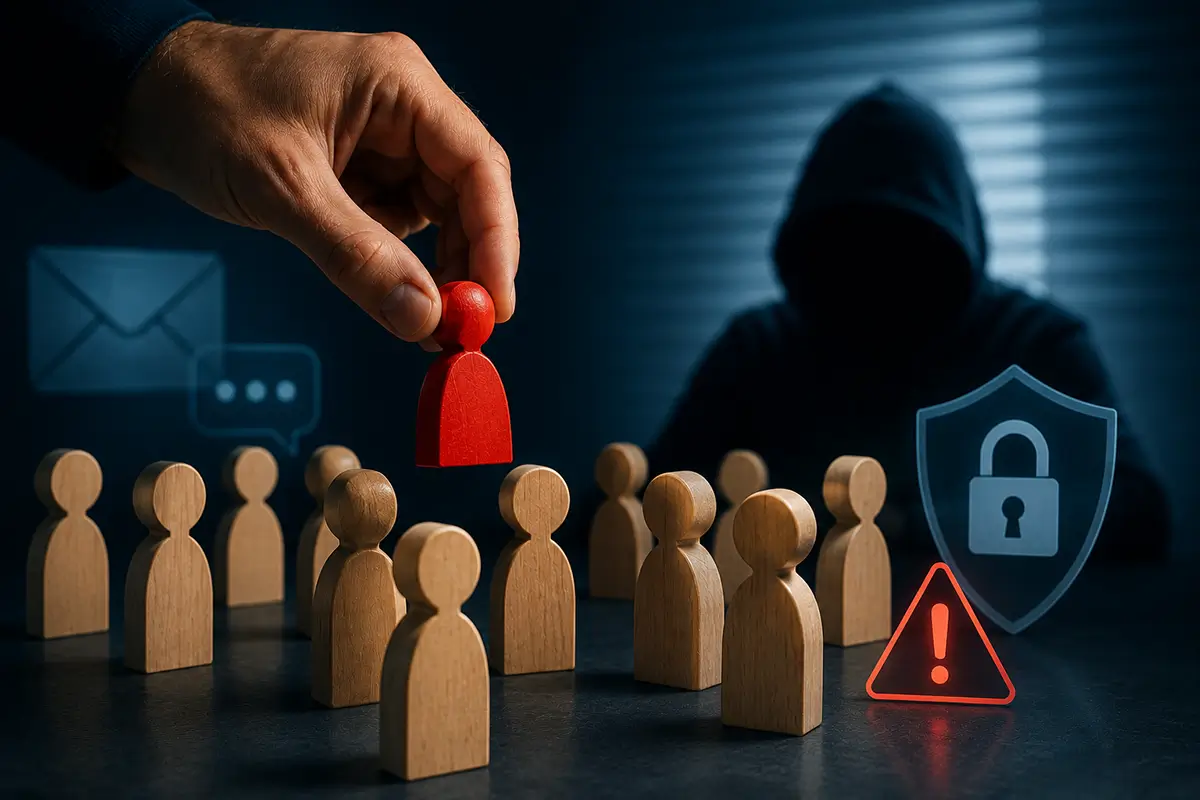
Protection Against Social Engineering: Why Technology Alone Is Not Enough
A few years ago, a cybercriminal would have needed considerable time to gather information about a company. Finding contacts, understanding the organizational structure, identifying decision-makers, and learning about internal systems often required extensive research.
Today, the process is much easier.
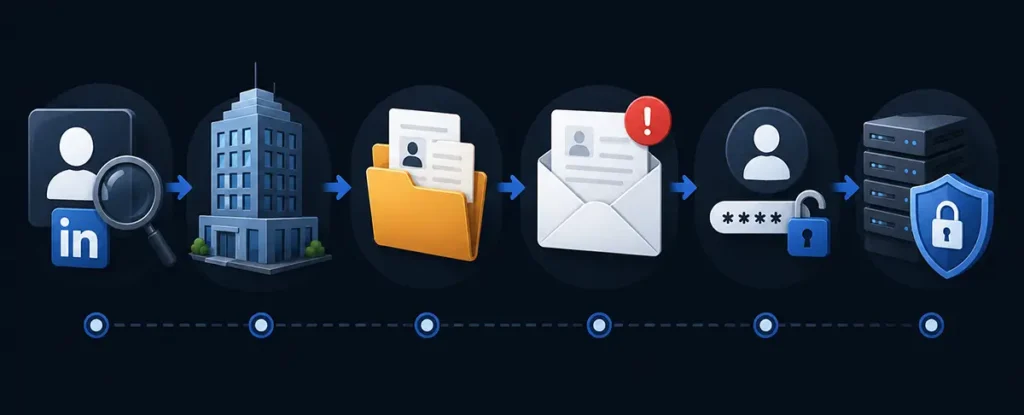
A quick visit to LinkedIn, a corporate website, or social media profiles can reveal who manages finance, who leads the IT department, what technologies are being used, and even what projects are currently underway.
That is why modern cyberattacks increasingly begin with people rather than technology.
Cybercriminals have learned a simple lesson: convincing someone to perform a specific action is often easier than bypassing multiple layers of technical security controls.
This approach is known as social engineering.
What Is Social Engineering?
Social engineering is the practice of manipulating people into voluntarily disclosing information, granting access, approving actions, or performing tasks that ultimately benefit an attacker.
Unlike traditional hacking, social engineering does not attempt to break through security systems directly. Instead, it uses trust, urgency, authority, fear, or simple human distraction to achieve its goals.
For this reason, victims are not limited to inexperienced users. Executives, system administrators, finance managers, lawyers, and experienced IT professionals have all fallen victim to social engineering attacks.
The issue is not a lack of intelligence or technical knowledge. The issue is that every person is capable of making mistakes.
Modern attackers understand this reality extremely well.
Why Social Engineering Works
When organizations think about cybersecurity, they often focus on firewalls, endpoint protection, intrusion detection systems, cloud security platforms, and other technical controls.
All of these technologies are important.
However, every one of them ultimately relies on human decisions.
Employees open emails, approve payments, install software, review documents, and authenticate into business systems. This makes people one of the most attractive entry points for attackers.
A criminal may spend weeks searching for a software vulnerability. Alternatively, they may convince a user to click a malicious link within minutes.
In many cases, the second option is significantly easier.
Social engineering campaigns often exploit urgency because urgency reduces critical thinking. Messages such as “Your account will be suspended,” “A payment requires immediate approval,” or “Suspicious activity has been detected” are designed to trigger fast reactions instead of careful analysis.
The goal is simple: make the target act before they think.
Why Smart People Still Become Victims
One of the most common misconceptions about social engineering is the belief that only inexperienced users fall for it.
Real-world incidents tell a different story.
Executives approve fraudulent transfers. Developers install malicious software. Finance teams process fake invoices. Administrators unknowingly validate unauthorized access requests.
These incidents happen because social engineering exploits normal human behavior rather than technical weaknesses.
People naturally trust authority. They want to be helpful. They try to complete tasks efficiently. They respond to urgent requests and often operate under pressure.
Attackers build their strategies around these predictable behaviors.
Instead of breaking technology, they manipulate decisions.
How Modern Social Engineering Attacks Are Prepared
Today’s attacks rarely begin with the first email or phone call.
Most successful campaigns start with research.
Attackers collect information from public sources, including corporate websites, LinkedIn profiles, press releases, job postings, conference presentations, and social media activity.
A job advertisement may reveal which cloud services a company uses. A LinkedIn profile may identify members of the finance department. A press release may reveal the name of a new supplier or business partner.
Individually, these details seem harmless.
Together, they can provide everything an attacker needs to build a highly convincing scenario.
This is one reason why modern social engineering attacks often appear far more credible than the phishing campaigns of the past.
They are personalized, targeted, and carefully planned.
Common Types of Social Engineering Attacks
Phishing
Phishing remains the most widely recognized form of social engineering.
The attacker sends a message containing a link to a fraudulent website that closely resembles a legitimate service. Once the victim enters credentials or authentication codes, the attacker gains access.
Corporate email accounts, cloud services, VPN platforms, and collaboration tools are common targets.
Vishing
Vishing, or voice phishing, uses phone calls instead of emails.
The attacker impersonates a bank representative, technical support specialist, vendor, or executive. Through persuasion and pressure, they attempt to obtain sensitive information or convince the victim to perform a specific action.
Because voice communication feels personal and immediate, these attacks can be extremely effective.
Smishing
Smishing refers to attacks delivered through SMS messages or messaging applications.
Notifications about package deliveries, account suspensions, payment confirmations, or security alerts are frequently used to lure victims into clicking malicious links.
Mobile devices often make it harder to inspect URLs and verify authenticity, increasing the likelihood of success.
Business Email Compromise and CEO Fraud
Some of the most financially damaging attacks involve impersonating company executives or trusted business partners.
Attackers request urgent wire transfers, changes to payment details, or access to confidential information.
What makes these attacks particularly dangerous is that they often involve no technical compromise at all.
The entire operation depends on trust, authority, and effective communication.
The Role of Social Media
Social media platforms have become powerful tools for attackers.
LinkedIn, in particular, provides valuable information about company structures, employee responsibilities, technology stacks, and business relationships.
Combined with information gathered from corporate websites and public records, social media helps attackers create highly personalized attack scenarios.
The more information that is publicly available, the easier it becomes to build trust and credibility.
Why Security Awareness Training Is Not Enough
Employee training is an essential part of cybersecurity.
People should understand how phishing works, how to recognize suspicious requests, and how to respond to unusual situations.
However, training alone cannot eliminate risk.
Employees work under deadlines. They multitask. They attend meetings, answer calls, respond to emails, and manage competing priorities.
No organization can realistically expect perfect attention and flawless decision-making every day.
This is why modern cybersecurity increasingly focuses on resilience rather than perfection.
The objective is not to eliminate human mistakes. The objective is to ensure that a single mistake does not result in a major security incident.
Passwords: The Primary Target
Most social engineering attacks ultimately aim to obtain access credentials.
Passwords remain one of the easiest targets because they are secrets that people can voluntarily reveal.
A password can be typed into a fake website, shared over the phone, written on paper, or stored insecurely.
Its complexity becomes irrelevant once it has been disclosed.
As organizations grow and adopt more cloud services, remote work models, and third-party integrations, password-related risks increase significantly.
MFA Is Important, But Not Perfect
Multi-factor authentication (MFA) significantly improves security by requiring an additional verification step beyond a password.
SMS codes, authenticator applications, push notifications, and hardware tokens all provide stronger protection than passwords alone.
For many organizations, implementing MFA is one of the most effective security improvements they can make.
However, not all forms of MFA provide equal protection against social engineering.
Users can still disclose one-time codes, approve fraudulent requests, or fall victim to phishing sites designed to capture authentication factors.
Some attacks even exploit what security professionals call MFA fatigue, where users receive repeated authentication prompts until they eventually approve one simply to stop the notifications.
Phishing-Resistant Authentication and FIDO2
The next evolution of authentication focuses on eliminating opportunities for credential theft altogether.
Standards such as FIDO2 and WebAuthn use cryptographic key pairs rather than shared secrets.
Each service receives its own unique credentials. If a user accidentally visits a fake website, the authenticator cannot use credentials intended for the legitimate service.
This creates a fundamentally different security model.
Instead of relying entirely on human vigilance, the authentication architecture itself prevents many common attack scenarios.
That is why phishing-resistant authentication is increasingly viewed as one of the most effective defenses against modern social engineering attacks.
Why This Is a Business Issue, Not Just an IT Issue
Social engineering is often treated as a technical cybersecurity problem.
In reality, its consequences are business consequences.
Successful attacks can lead to operational disruption, financial losses, regulatory exposure, reputational damage, and loss of customer trust.
Executives do not need to become experts in cryptography or authentication protocols.
However, leadership teams are responsible for determining acceptable levels of risk and making decisions about security investments.
When critical systems remain protected by outdated authentication methods, the issue is no longer purely technical. It becomes a management decision.
Building Effective Protection Against Social Engineering
There is no single solution that completely eliminates social engineering risk.
Effective protection requires multiple layers.
- Security awareness and employee education
- Clear procedures for financial transactions and access requests
- Multi-factor authentication for critical systems
- Phishing-resistant authentication for high-risk accounts
- Regular security assessments and policy reviews
The goal is not to create a perfect environment. The goal is to reduce risk and ensure that a single human mistake cannot compromise the entire organization.
Not sure how secure your accounts are?
We will help you assess your current authentication mechanisms and advise you on solutions that will reduce the risks of phishing, account compromise, and other modern attacks.
Discuss the SolutionConclusion
Social engineering has existed for as long as trust itself. Technology has changed, but human psychology remains largely the same.
Modern attackers increasingly focus on manipulating people rather than attacking systems directly.
That is why protection against social engineering requires more than awareness training alone.
Organizations need security architectures that acknowledge human limitations and continue to provide protection when mistakes inevitably occur.
Modern authentication technologies, including MFA and phishing-resistant solutions based on FIDO2, play an important role in achieving that goal.
Ultimately, protection against social engineering is not only a cybersecurity challenge. It is a business decision about how an organization chooses to protect its people, its data, and its future.