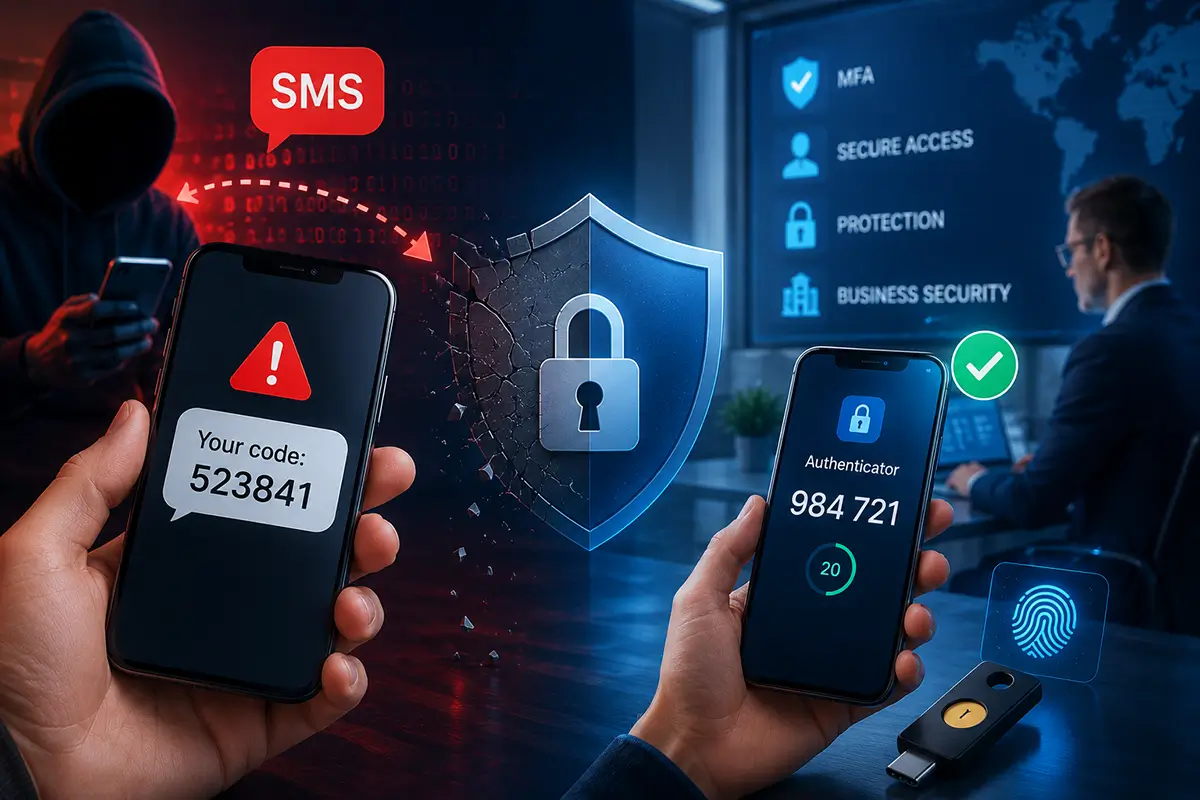
Why SMS Codes Are No Longer Enough to Protect Business Accounts
For many years, SMS codes were considered a simple and reliable way to add an extra layer of protection to online accounts. A user entered a password, received a short code on a phone, and used it to confirm the login.
For a long time, this approach worked reasonably well. It was much better than relying on a password alone. But today, business security requirements have changed. Cyberattacks have become more targeted, phishing pages look more convincing, and attackers often focus not on breaking systems, but on stealing user access.
That is why SMS-based authentication is no longer considered a strong enough protection method for critical business systems.
Why SMS Authentication Became Popular
SMS codes became popular because they were easy to understand and simple to implement. Users did not need special devices or technical knowledge. They only needed access to their mobile phone.
For many companies, this was the first step toward two-factor authentication. Instead of using only a password, employees had to confirm login with a code sent to their phone.
This made account compromise more difficult. However, SMS messages were never designed as a highly secure authentication channel.
Main Weaknesses of SMS Codes
SIM Swapping
One of the most serious risks is SIM swapping. In this type of attack, a criminal gains control over a victim’s phone number by transferring it to another SIM card.
After that, SMS codes are no longer delivered to the real owner of the account. They go to the attacker instead.
For a private user, this is already a serious problem. For a business, it can lead to unauthorized access to corporate email, VPN, cloud platforms, or internal systems.
SMS Interception
SMS messages depend on mobile networks and external telecom infrastructure. In some cases, messages can be intercepted, redirected, or delayed.
This may not be a daily risk for every company, but for organizations dealing with sensitive data or targeted attacks, it is a real weakness.
Phishing
Another important problem is phishing. A fake login page may ask the user to enter both a password and an SMS code.
If the user does not notice that the page is fake, both factors can be stolen at the same time. This means that SMS authentication does not always protect against modern phishing attacks.
Today, phishing pages can look almost identical to real Microsoft 365, Google, or banking login pages. That makes the problem even more serious for business users.
Dependence on Mobile Operators
SMS codes also depend on mobile operators. Messages may arrive late, fail to arrive, or create problems when a user changes a phone number or travels abroad.
For a business, such issues can block access to important systems at the wrong moment.
Why Companies Are Moving to MFA
Modern companies are gradually moving from SMS codes to stronger MFA methods. MFA stands for multi-factor authentication. It uses more secure ways to confirm a user’s identity.
Instead of SMS, companies often use:
- authenticator apps;
- push confirmations;
- FIDO2 security keys;
- hardware tokens;
- biometric verification;
- passwordless authentication.
These methods provide better protection against phishing, account takeover, and unauthorized access.
Why Modern MFA Is Better Than SMS
Modern multi-factor authentication is usually more secure and more convenient than SMS-based verification.
Authenticator apps generate one-time codes directly on the user’s device. They do not depend on mobile network delivery.
Push confirmations allow the user to approve or deny a login attempt and often show additional information about the request.
FIDO2 security keys provide an even higher level of protection. They are especially useful for administrators, DevOps teams, executives, and users who have access to critical systems.
One of the main advantages of FIDO2 is phishing resistance. A hardware security key is tied to the real domain, so a fake login page cannot use it in the same way as a stolen SMS code.
Where SMS Codes Are Especially Risky
SMS authentication may still be acceptable for some low-risk scenarios. But it is not the best choice for systems that are important to business operations.
Companies should be especially careful when SMS codes are used for:
- corporate email;
- Microsoft 365;
- Google Workspace;
- GitLab or GitHub;
- VPN access;
- cloud infrastructure;
- administrator accounts;
- financial systems;
- internal business platforms.
In these areas, stronger MFA methods are usually a much better choice.
Should Businesses Completely Stop Using SMS?
Not always. SMS codes are still better than using only a password. For some simple accounts, they may still be acceptable.
But for corporate systems, sensitive data, and administrator access, SMS should not be treated as the main security method.
A more practical approach is to gradually replace SMS with stronger MFA options where the risk is higher.
For example, companies can start with:
- corporate email accounts;
- administrator accounts;
- VPN access;
- GitLab or DevOps environments;
- cloud services;
- accounts used by management.
How Smart Lab Helps Businesses Move to Stronger MFA
Moving away from SMS authentication is not just a technical switch. The company needs to understand which systems are most important, which users require stronger protection, and how to keep authentication convenient for daily work.
Smart Lab helps businesses:
- assess current authentication risks;
- identify critical systems and accounts;
- choose the right MFA methods;
- configure FIDO2 security keys;
- integrate MFA with Microsoft 365, GitLab, VPN, and other services;
- create backup access scenarios;
- train employees to use MFA safely.
The goal is not only to improve security, but also to build an authentication process that works in real business conditions.
Need to Implement MFA or 2FA in Your Company?
Smart Lab will help you select and configure multi-factor authentication for corporate email, GitLab, VPN, cloud services, and internal systems.
Discuss the SolutionConclusion
SMS codes played an important role in the development of two-factor authentication. They helped many companies move beyond password-only protection.
However, modern cyber threats have shown the limitations of SMS-based authentication. SIM swapping, phishing, message interception, and dependence on mobile operators make SMS codes too weak for many business-critical systems.
Authenticator apps, push confirmations, FIDO2 security keys, and modern MFA solutions provide stronger protection for corporate accounts and infrastructure.
Smart Lab helps companies choose and implement secure MFA solutions that match their business needs, infrastructure, and real security risks.